If you can’t increase your return, increase your **time horizon**. It’s the most reliable lever.
Compounding snapshot
Real-life returns are uneven. The calculator uses an average rate to make planning easier, but it’s smart to stress-test 1–2% lower than your best guess.
“Wealth is usually built with boring consistency—then compounding makes it look like magic.”
Run your scenario in FinWizard
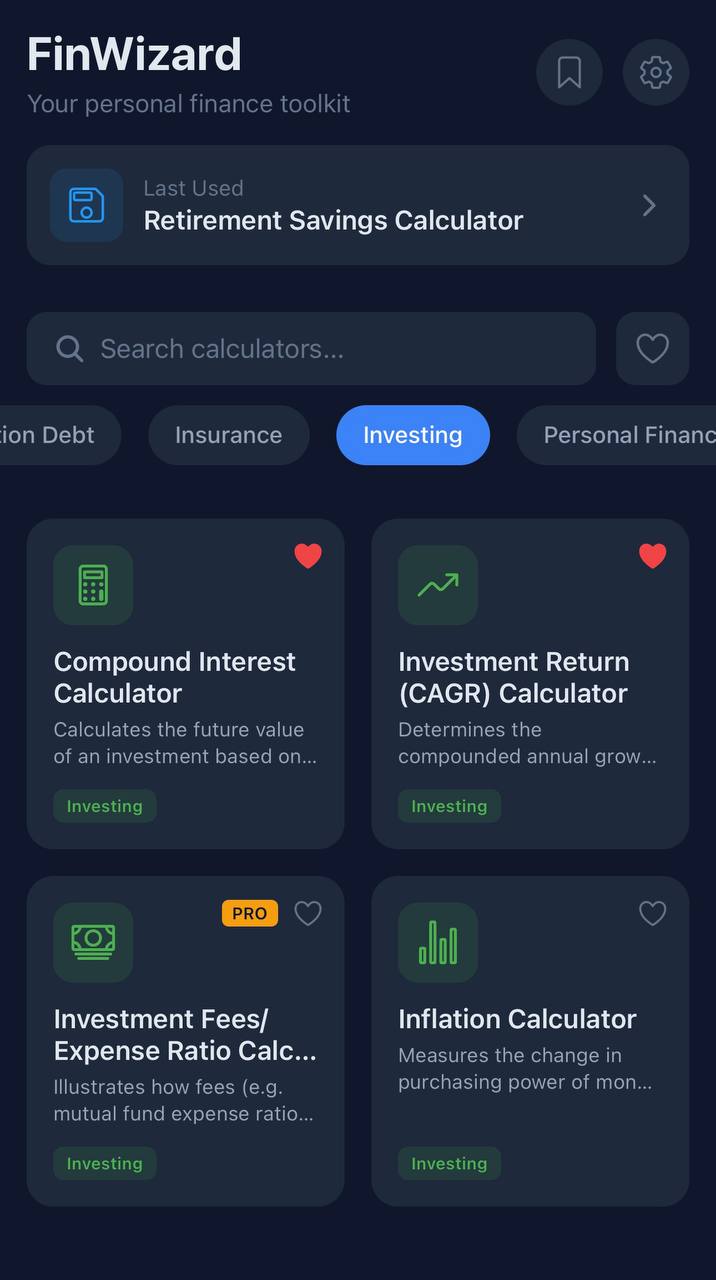
Use the compound interest calculator to test rates, timelines, and contributions—then save the scenario inside the app.
Section: Checklist
Step-by-step plan
**Set your starting balance and goal.** Define the amount you have now and the future balance you want.
**Choose realistic assumptions.** Use a conservative annual return, then stress-test higher and lower scenarios.
**Automate contributions.** Add monthly deposits so your plan compounds consistently.
**Pick a review cadence.** Quarterly is ideal — it’s frequent enough to adjust, but not so frequent that you chase noise.
**Increase contributions when income grows.** Even a small increase (1–2%) has an outsized effect over long timelines.
Key takeaways
- The compound interest calculator is most powerful when you update one variable at a time—rate, time, or contribution—to see which lever has the biggest impact.
- **Automate contributions.** Automation removes decision fatigue and keeps your plan moving.
- **Avoid large withdrawals.** A big withdrawal doesn’t just remove principal — it erases future compounding.
- **Don’t over-optimize.** A “good enough” plan executed for a decade beats a perfect plan executed for three months.
Ready to take control?
Join thousands of users who trust FinWizard for their daily financial calculations.